Museum Frieder Burda, Baden-Baden:
"IMPRESSIONISM IN GERMANY. Max Liebermann and his Times"
October 3, 2025 - February 8, 2026
With the exhibition Impressionism in Germany: Max Liebermann and His Times, the Museum Frieder Burda devotes itself to one of the most important artistic currents of the late nineteenth and early twentieth centuries – and the painter who helped it achieve a breakthrough in Germany. Max Liebermann (1847–1935) is considered a pioneer of German Impressionism, a movement whose luminous imagery and modern motifs are still captivating today. 108 works from more than sixty international collections offer fascinating insights into the German manifestation of a style that developed in Paris in the 1860s among artists such as Claude Monet and Pierre-Auguste Renoir.
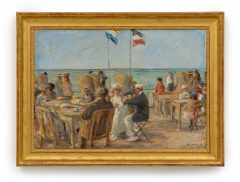
To this day, the brilliantly colored visual worlds of Impressionism exert a fascination unequaled by almost any other art movement. The painting that emerged in France in the 1860s was marked by intense, glowing colors and energetic, sketch-like brushwork. With Max Liebermann (1847–1935) as its pioneer, this revolutionary new approach soon set the tone for the avantgarde in the German Empire as well. Artists explored a wide range of motifs, from sundrenched landscapes and atmospheric figural scenes to meticulously arranged still lifes.
The show Impressionism in Germany: Max Liebermann and His Times is one of the largest exhibitions ever devoted to this theme and presents an opulent survey of the entire development of the movement, from the 1880s to the 1920s. World-famous pieces by artists including Max Liebermann, Lovis Corinth, Max Slevogt, and Fritz von Uhde are featured alongside works by painters whose contribution is well worth rediscovering – amongst them Dora Hitz, Philipp Franck, Gotthardt Kuehl, Christian Landenberger, Sabine Lepsius, and Max Uth.
From the beginning, the influence of France played a key role in the development of German Impressionism. Liebermann and many other painters drew inspiration from the works of their French colleagues, which they studied during prolonged stays in Paris. Back in Germany, galleries such as the Kunstsalon of Paul Cassirer in Berlin regularly exhibited paintings by Edgar Degas, Claude Monet, Pierre-Auguste Renoir, and others. To the emperor’s outrage, the director of the Nationalgalerie, Hugo von Tschudi, acquired important examples of modern French painting as early as the 1890s. Liebermann amassed a top-tier collection of such works, which guests could admire at his villa in Wannsee. Like Claude Monet in Giverny, he also planted an elaborate garden in Wannsee from 1909 on, and its floral splendor became the primary motif of his late Impressionist oeuvre.
Die Schau im Museum Frieder Burda feiert Liebermann nicht nur als eine zentrale künstlerische Position, sondern beleuchtet auch seinen herausragenden Einfluss als Sammler, Ausstellungsmacher und Mentor. Im erzkonservativen Kaiserreich war der jüdische Maler auch als Präsident der Berliner Secession eine mutige Stimme für Fortschritt, Internationalität und Neuerung – und einer der wichtigsten kulturpolitischen Akteure der deutschen Hauptstadt. In dem zunehmend intensiven Dialog mit Frankreich spielte Liebermann ebenfalls eine zentrale Rolle. Bereits im Zuge der Exposition universelle von 1889 hatte ihm der französische Staat eine Ehrenmedaille verliehen und ihn zugleich als einen der ersten deutschen Künstler überhaupt in die prestigereiche Société des Beaux-Arts aufgenommen. Sein Genrebild Biergarten in Brannenburg (1893, Musée d’Orsay, Paris) wurde fünf Jahre später für das Musée du Luxembourg in Paris erworben. 1896 folgte Liebermanns Eintritt in die französische Ehrenlegion – eine äußerst symbolträchtige Auszeichnung, deren Annahme ihm die nationalkonservative preußische Regierung zunächst verweigert hatte
Liebermann starb zwei Jahre nach der Machtergreifung der Nationalsozialisten, die der Entwicklung der modernen Malerei in Deutschland ein jähes Ende gesetzt hatte. Seine Witwe Martha Liebermann wählte 1943 wenige Tage vor ihrer geplanten Deportation in das Konzentrationslager Theresienstadt den Freitod. Ihre Tochter Käthe und die junge Enkelin Maria waren bereits 1938 ins US-amerikanische Exil geflohen. Liebermanns umfangreiche Sammlung zur Malerei des französischen Impressionismus ist heute in alle Winde verstreut und befindet sich in großen Teilen in Sammlungen jenseits des Atlantiks. Seine Künstlervilla am Wannsee ist heute nicht nur ein bedeutendes kulturelles Vermächtnis, sondern auch ein politisches Mahnmal.
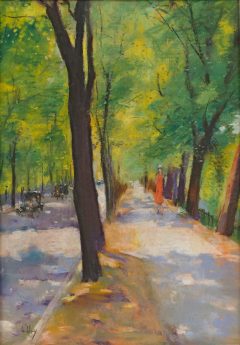
Die Ausstellung im Museum Frieder Burda würdigt Liebermanns Beitrag zur deutschen Kunst und Kultur im erweiterten Kontext der impressionistischen Avantgarde. Sortiert sind die 108 Arbeiten von 21 Malerinnen und Malern nach acht thematischen Kapiteln: Bildwürdige Alltagsszenen. Genremalerei, Maler des modernen Lebens. Bürgerliche Muße, Dramatische Posen. Die Welt als Bühne, Die Stadt als Schauspiel. Urbane Szenen, Große Erwartungen. Kinderbildnisse, Dynamik und Frische. Draußen im Freien, Befreiung der Farbe. Stillleben, Irdisches Paradies. Liebermanns Künstlergarten und „Hortus conclusus. Der Garten als Refugium".
Zu den zahlreichen Höhepunkten der Ausstellung gehören Ikonen des deutschen Impressionismus wie Max Liebermanns Simson und Delila (1902, Städel Museum, Frankfurt am Main), Lovis Corinths Dame am Goldfischbassin (1911, Belvedere, Wien), Max Slevogts Champagnerlied (1902, Staatsgalerie Stuttgart) oder Fritz von Uhdes Kinderstube (1889, Hamburger Kunsthalle).
Another focus is a group of important works by women painters such as Dora Hitz, Sabine Lepsius, Marina Slavona, and Eva Stort, who are largely forgotten today but were able to achieve artistic success in the German Empire