Henri Lebasque
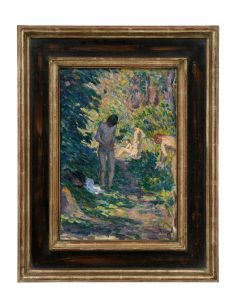
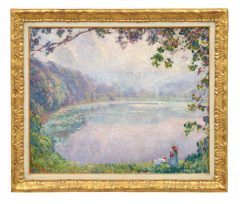
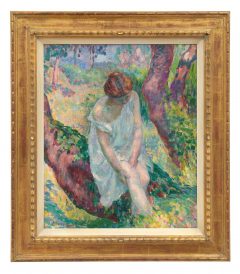
Henri Lebasque was a French painter best known for his vibrantly coloured works of late Impressionism. He was born in 1865 in Champigné, France, and began his artistic studies at the École supérieure d'art et de design TALM-Angers, and later at the École des Beaux-Arts in Paris. He subsequently continued his studies under Henri Harpignies, an established landscape painter, where he deepened his understanding of composition, light and the effects of colour. Early contacts with artists such as Camille Pissarro and Pierre-Auguste Renoir, as well as exchanges with Pierre Bonnard and Édouard Vuillard, leading members of the Nabis, had a lasting influence on his artistic understanding. Later, he also met Georges Seurat and Paul Signac, from whom he adopted new perspectives on colour, light and complementary effects. From the 1890s onwards, Lebasque developed a distinctive style characterised by warm, luminous colours, subtle lighting effects, and depictions of everyday scenes, landscapes, and portraits of family and friends. He worked in both oil and pastel, with his pastel works distinguished by soft transitions and intense colour. Lebasque exhibited regularly at major Parisian salons, including the Salon des Indépendants and the Salon d’Automne, and also presented his work internationally, notably in London and New York. Trips to the south of France, particularly to Saint-Tropez, as well as stays in Brittany and Normandy, shaped his motifs and led to a lighter, light-flooded colour palette. Today, his works are held in numerous public and private collections, including the Musée d’Orsay in Paris. Henri Lebasque died in Paris in 1937. His work is regarded as a significant testament to early 20th-century French painting, characterised by light, colour, composition and a sensitive depiction of everyday life.

- Prices include German VAT. Exclusive of shipping costs for delivery to the European Union. All prices are subject to change and availability. Change region and currency