Oskar Schlemmer
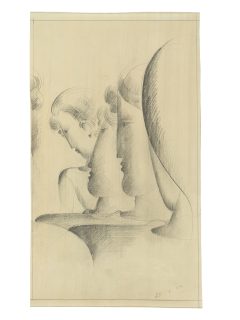
Oskar Schlemmer was not only a painter and sculptor, but also a dancer, choreographer and stage designer. He was one of the most versatile artists of classical modernism. As a Bauhaus master, he made a name for himself with his interdisciplinary approach of incorporating movement, dance and theatre into the visual arts. From 1905 to 1909, Schlemmer studied at the School of Applied Arts and the Academy of Fine Arts in Stuttgart. In 1911, while in Berlin, he became acquainted with both the formal analysis of Cubism and the French avant-garde, and exhibited at the Der Sturm gallery. In 1920, he was appointed by Walter Gropius as head of the sculpture department and stage workshop at the Bauhaus in Weimar. He taught nude drawing and the course “Der Mensch” (The Human Being) until 1929, designed the Bauhaus logo, directed the theatre stage and organised the legendary Bauhaus parties. In 1922, he achieved his international breakthrough with the premiere of his “Triadic Ballet”. His wide-ranging activities as a wall designer, sculptor, draughtsman and painter show that he strove throughout his life to create a Gesamtkunstwerk, or total work of art. The human being, depicted as a typified figurine, remains the dominant theme of his painting, which he shapes into geometric image structures under the influence of Cubism. In 1932, he was appointed professor at the United State Schools in Berlin, but the National Socialists revoked his position in 1933. During the war years, Oskar Schlemmer worked in seclusion and was considered a “disgraced” artist. In 1937, however, a major solo exhibition was dedicated to him at the London Gallery. Today, his works can be found in the Museum of Modern Art, New York, the Staatsgalerie Stuttgart and the Kunstmuseum Basel, among others.





- Prices include German VAT. Exclusive of shipping costs for delivery to the European Union. All prices are subject to change and availability. Change region and currency