Otto Dix
Technisches Personal
1922
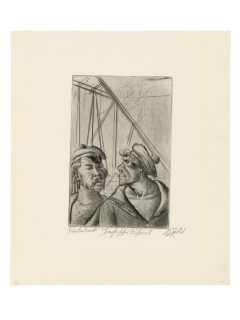
drypoint on vellum
Image: 30 × 19.8 cm | 11 13/16 × 7 13/16 in
Sheet: 49.8 × 43.2 cm | 19 5/8 × 17 in
Signed, "22" dated, titled and marked "Probedruck"
Edition of 50 + trial proofs; from the portfolio "Zirkus"; Editor: Otto Dix
Catalogue Raisonné by Karsch 1970 no. 39 II
Price includes German VAT. Shipping costs are not included. All prices are subject to change and availability. Change region and currency
Private Collection Rhineland
- Florian Karsch (Hg.), "Otto Dix. Das grafische Werk, eingeleitet von Hans Kinkel", Hannover 1970, Nr. 39 II, Abb. S.62
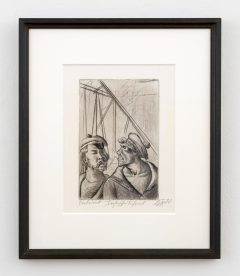
In his 1922 drypoint etching "Technisches Personal", Otto Dix turns his distinctive gaze towards the people who exist beyond the main circus ring. Two men are depicted in striking close-up, their distinctive physiognomies, tattooed bodies and individual facial features rendered with almost uncompromising precision. What the title initially presents as a functional occupational category reveals itself, upon closer examination, to be a nuanced portrait of human individuality. Dix is drawn to the immediacy and unguarded presence of his subjects, capturing not only their physical presence but also the traces of their lived experience. His precise and finely nuanced use of line combines exceptional draughtsmanship with the analytical powers of observation that characterise his graphic work of the early 1920s.
The print is part of the ten-work Circus Portfolio of 1922, a significant body of work within Dix’s graphic oeuvre. In this series, the artist explores the world of the circus in all its ambiguity, caught between fascination and disillusionment, illusion and reality. Alongside performers and showpeople, particular attention is given to those whose work makes the spectacle possible, yet who remain outside the spotlight themselves. The circus thus becomes a metaphor for society, whose diverse manifestations Dix observes with an unflinching eye. It is precisely in his depiction of these seemingly peripheral figures that his particular interest in the individuality and distinct character of each human being becomes apparent. The Circus Portfolio is therefore an exemplary expression of Dix’s early New Objectivity approach, in which social observation, psychological characterisation and a masterful command of printmaking techniques come together to create a compelling visual language.